
RFC APRIL 1885
Practice Matches and a Ghost Sign.

April 1885
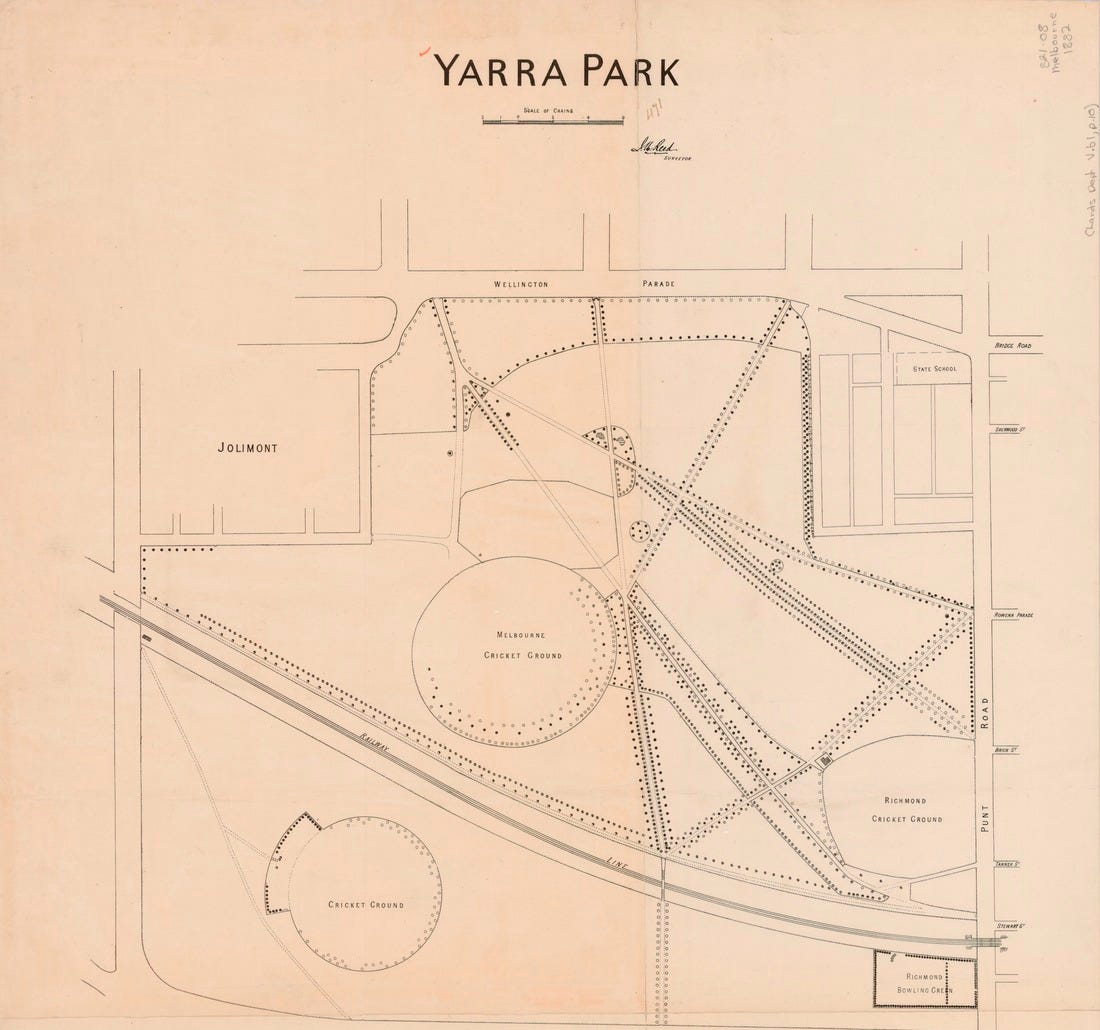
“Two of the principal paths, from the north, that lead to the RCG are to be planted with shade trees, and the gap in the avenue on the pathway from Wellington-parade to the RCG will be filled.”
- Richmond Australian April 4.
The below map from 1882 by J.Noone shows Yarra Park and its paths leading to the RCG. 3 years prior showing paths leading to the RCG. Though not too sure where the “gap in the avenue” will be.
Saturday April 4 1885
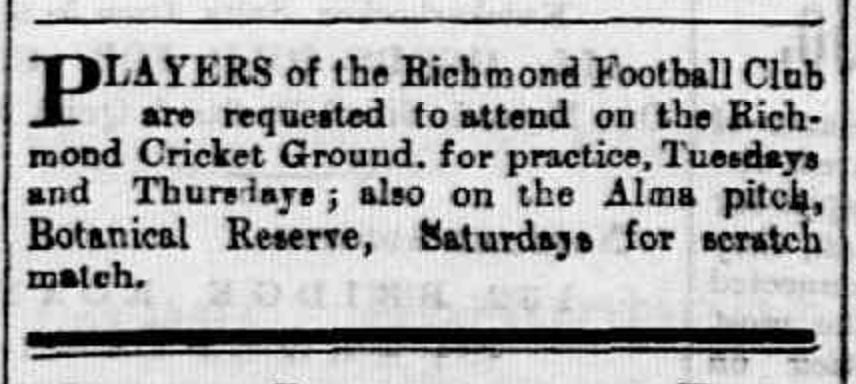
Advertisement in the Richmond Australia announces that Richmond will train on Tuesdays and Thursdays on the RCG, and that scratch matches will be played on the Alma pitch, Botanical Reserve (Gosch’s paddock) each Saturday.
“It is desired that players turn up with punctuality and regularity for practice, as it is wanted to get the team selected.”
THE FIXTURE
Richmond’s 1885 fixture is also published in the Richmond Australian.
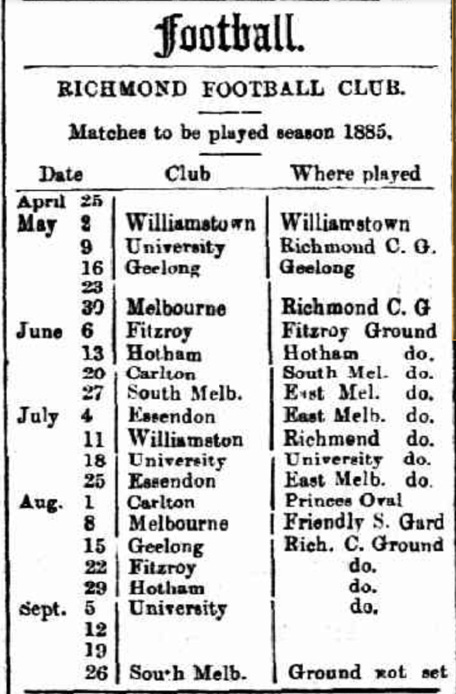
The September 26th match v South Melbourne will ultimately be played at Friendly Societies Ground.
Unsure atm why Richmond didn’t play a game between Sept 6 and Sept 26. The Weekly Times published the fixture the same day and lists those dates as vacant.
Have added this question to the Hmmm page
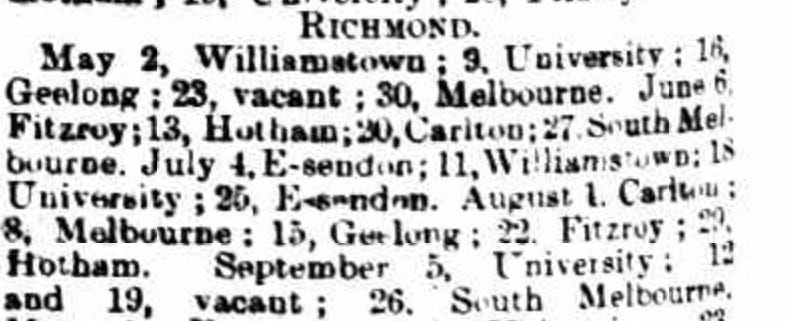
Oh and the fixture is also published as part of Boyle and Scott’s “List of Football Matches and Rules of the Game for 1885” booklet. The booklet measured 9.6cm x 6.4cm
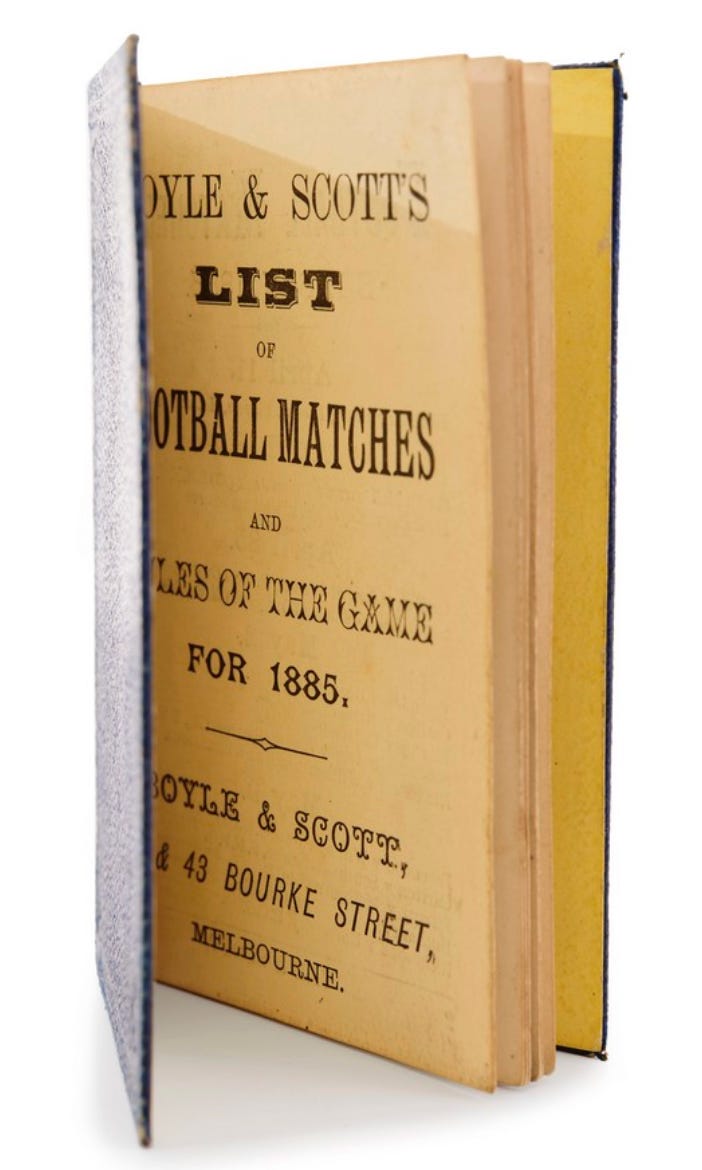
The exact date of publication of Boyle and Scott’s booklet is unknown. The Herald would report on April 11 that “we have received from Messrs Boyle and Scott, in a neat book the list of football matches for the coming season.”
The Richmond Australian reports that:
‘most of the club membership tickets have been sold by this date”.
That’s a pretty good sign considering we uncovered the tickets first went on sale on March 7 , so it took only 28 days for most to be snapped up. (Trevor Ruddell wrote the club had 300 members for 1885).
GOAL POST PAINTING
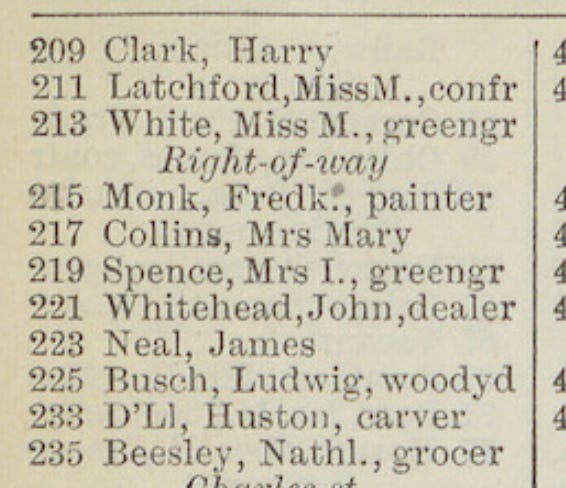
Frederick Monk, a painter from Swan Street offers to paint the goal posts “the Richmond colors”. That would mean a yellow, black, and possible blue colour scheme.
(The only image we have of the goalposts from 1885 is a small sketch as printed in the February newsletter, but that doesn’t show anything definitive).
Monk was born in 1845 in Gravesend, Kent in England and was a painter and paperhanger at 171 Swan Street. He died aged 78 on July 5 1923 at his residence “The Cabin” in Brighton. I’m yet to find a photo of him.
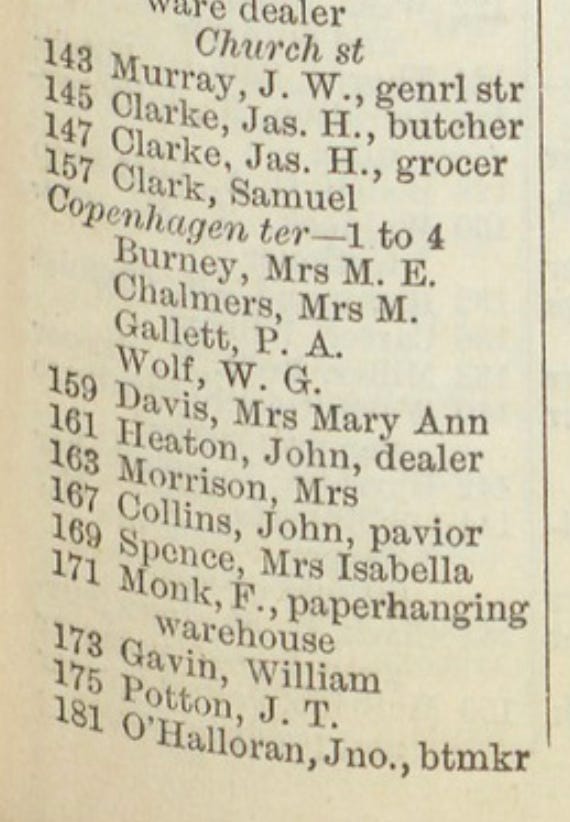
The renumbering of Swan Street turned his building into 215 Swan Street.
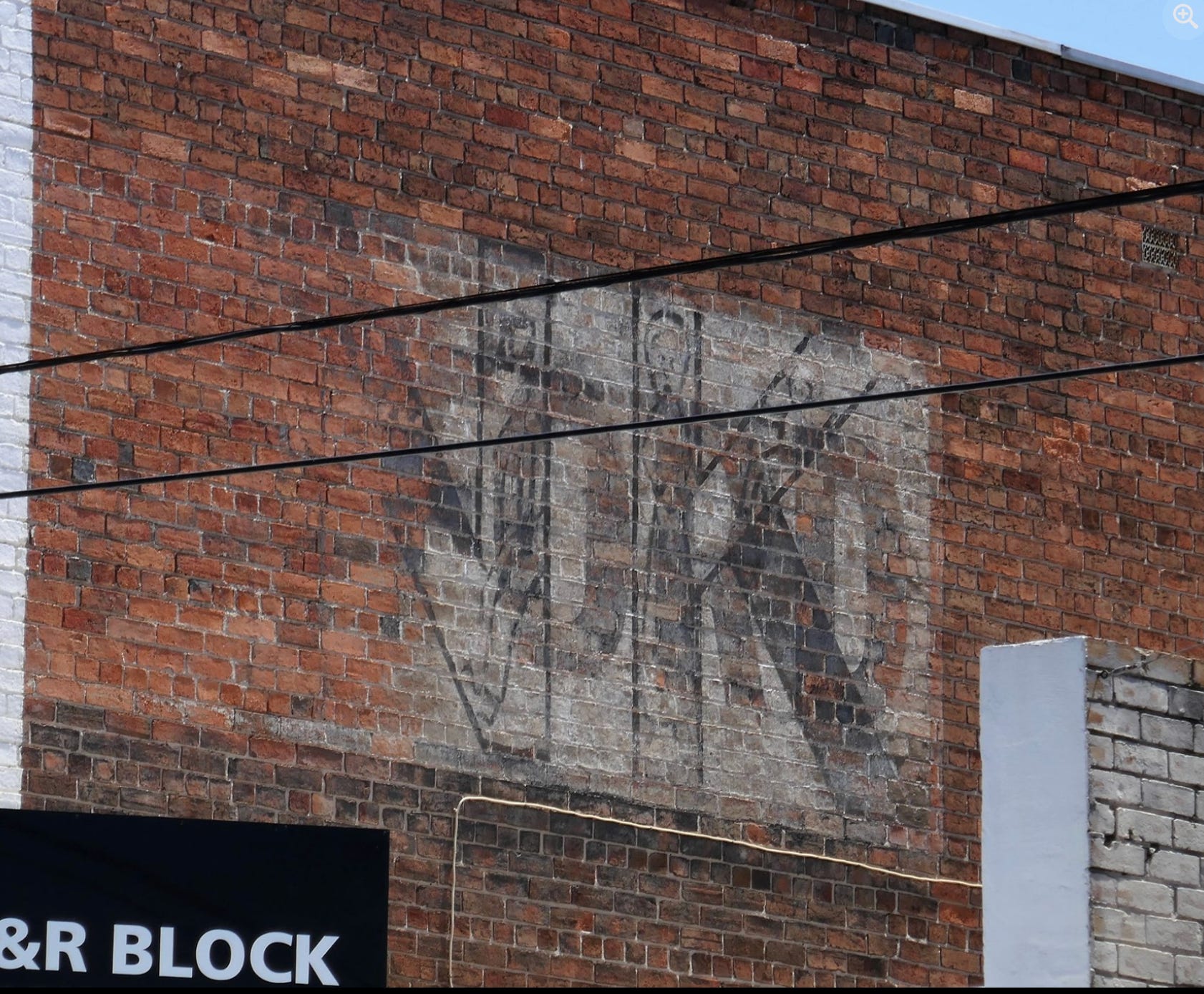
Incredibly, in 2019, the photographers for Melbourne Ghost Signs facebook page captured the remains of Monk’s signage on the side wall of 215 Swan Street.
At the time, and up until publication of this newsletter, they were unsure what the ‘NK’ related to - but its clearly part of Monk’s surname. What appears to be male and female drawings are visible within the lettering.
(the ‘ORD’ thats visible belong to signage when G.M.Setford occupied the building).
A public notice in The Age advertises that a cow and calf are for sale from the RCG.

Saturday April 11
The first ever scratch match of the Richmond side is played on the Alma Pitch, Botanical Reserve. But there’s no detail on the result.
April 18th issue of Richmond Australian is missing on Trove, and April 18th issue of Richmond Guardian makes no mention!
Saturday April 18
Richmond’s first twenty play at the Botanical Reserve at 3pm against “the next 23” (18/4 RG), and give them a “sound drubbing” (20/4 Age)
The Age says they played ‘twenty-five all comers’, two more than what the Richmond Guardian previewed. Again, no details of the scores.
Saturday April 25
Non-Premiership match
Richmond 2.12 def “a promising junior club” Cremorne (23 players) 1.4 on the RCG.
Notes:
Players were to be on the ground by 3pm.
A pleasant wind-less day, with a pretty good attendance considering there were 10,000 spectators over at the MCG watching the Caledonian Society sports day.
Members ticket admits a lady to the game.
King Mitchell is umpire.
George Smith is captain. Tom Graham is vice.
THE SQUAD
The Richmond squad, as published in the Richmond Guardian, and Richmond Australia are almost identical, except for a couple of typos and the absence of player Carroll in the latter’s article.
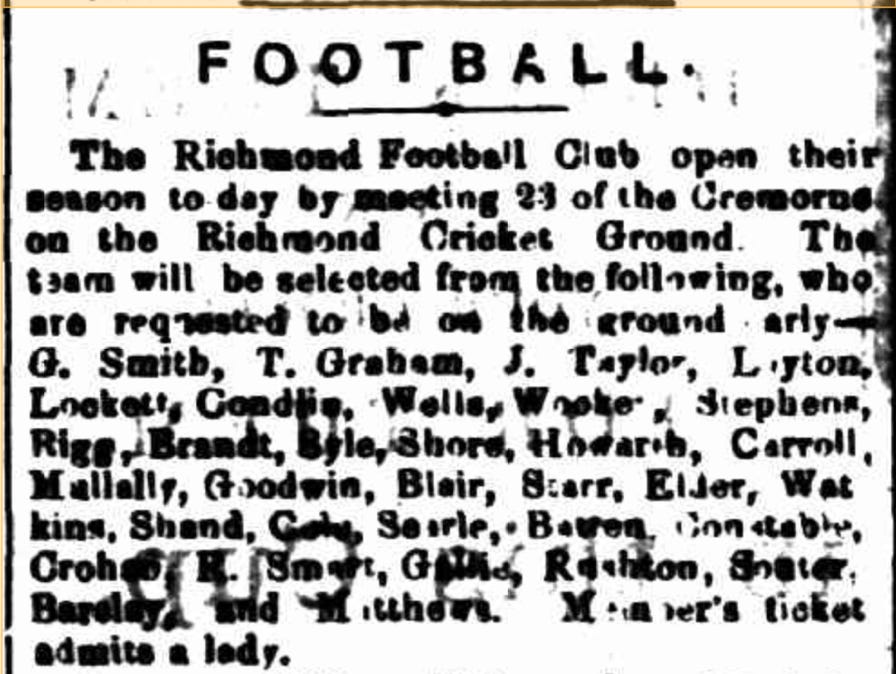
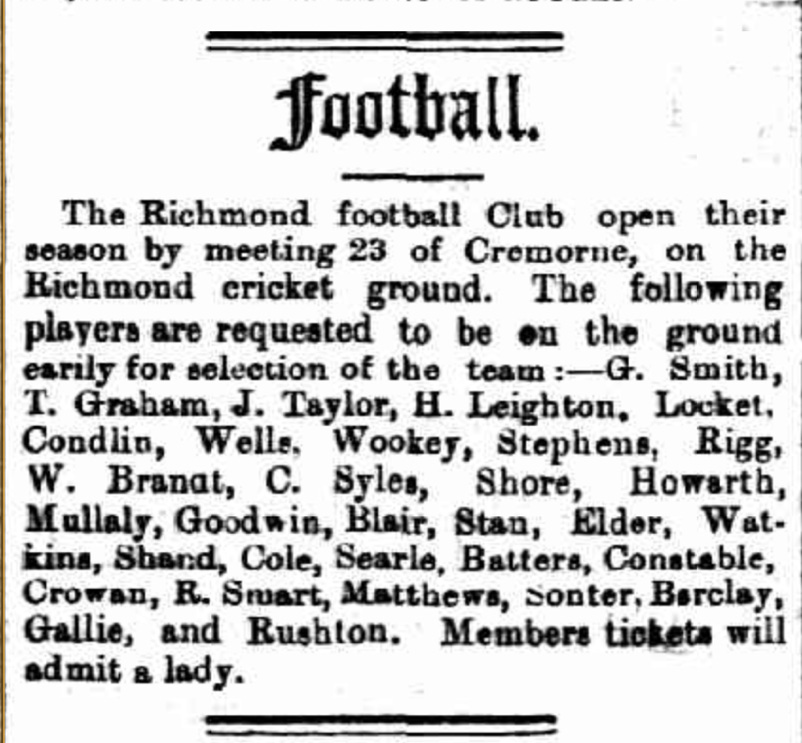
Here’s a brief run-down of all the names mention in this first ever squad with their first names where known.
George Smith, Tom Graham, Jack Taylor, Harry Layton, (unknown) Lockett, Jack Conlon, Billy Wells, Fred Wookey, Charlie Stephens, (unknown) Rigg, (unknown) Brandt, Chris Syle, Jimmy Shore, George Howarth, Billy Carroll, James Mullally, Jack Goodwin, (unknown) Blair, (unknown) Starr, Alf Elder, (unknown) Watkins, Joseph Shand, (unknown) Coles, Alf Searle, (unknown) Bowen, (unknown) Constable, Frank Crohan, R or T Smart, (unknown) Gallie, William Rushton, (unknown) Souter, (unknown) Barclay, and Matthews.
Using newspaper reports, we can identify at least 12 players we know actually took the field. They are marked above in bold, along with Paddy Purcell (who was not listed in the original squad).
The Richmond Australia however also reported that
“For Richmond, G Mitchell played in his usual capital form.”
There’s no G Mitchell listed in our squad, and despite Pennings in his book listing him as a player, I’m skeptical and wonder if it is a typo and meant to say the captain “G Smith”. He was a champion player previously at Carlton and the above quote makes more sense if it is him.
(The author may have confused the surname with the umpire “Mitchell”, who he mentions later in the article).
THE ADDRESS
Vice President James Francis Lancashire addresses the team before the match and referred to the interest taken by Richmondites in athletics sports.
The Richmond Guardian wrote that:
“It behoved the members to play the game and act in such a spirit as to uphold the honor of the Richmond Football Club.”
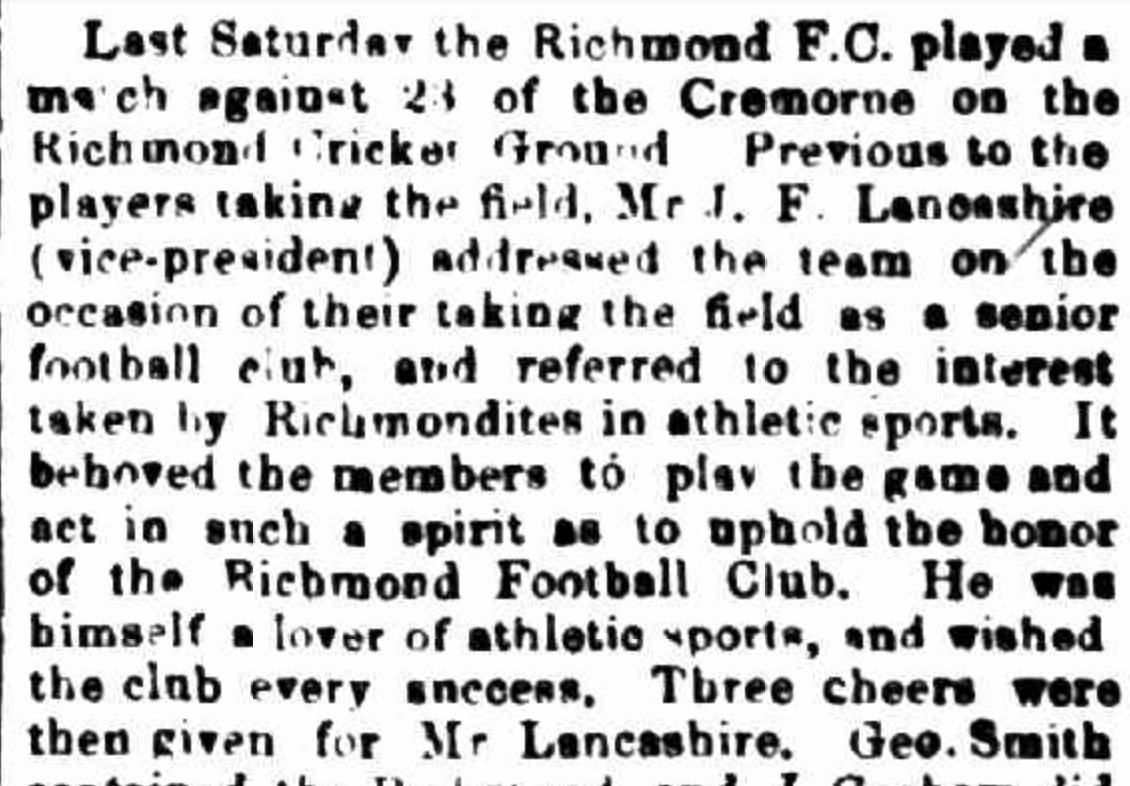
As you can see from the above extract, it’s not actually a direct quote from Lancashire to the players. There’s no quotation marks.
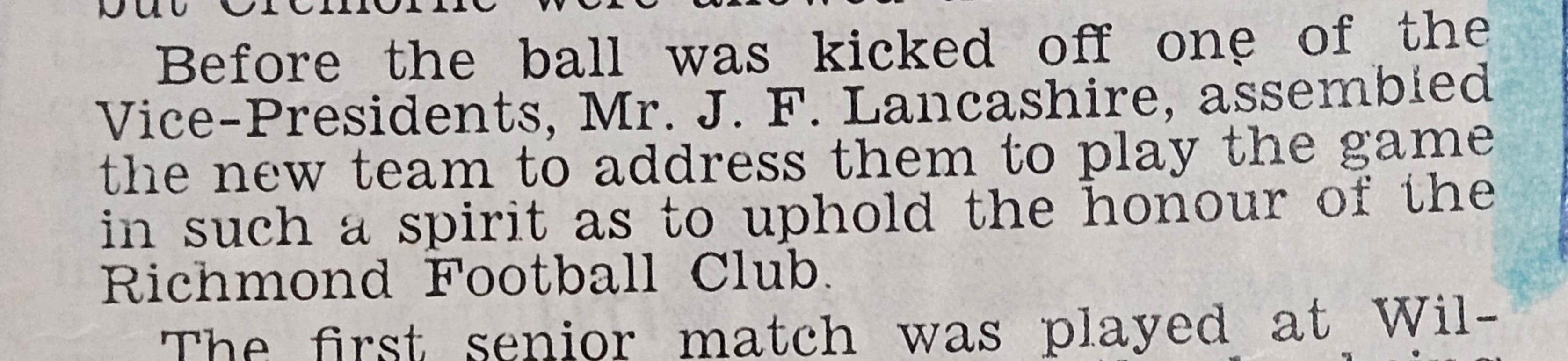
But this paragraph would be altered for print in Clonard’s 1934 book as a direct quote, and with extra words!
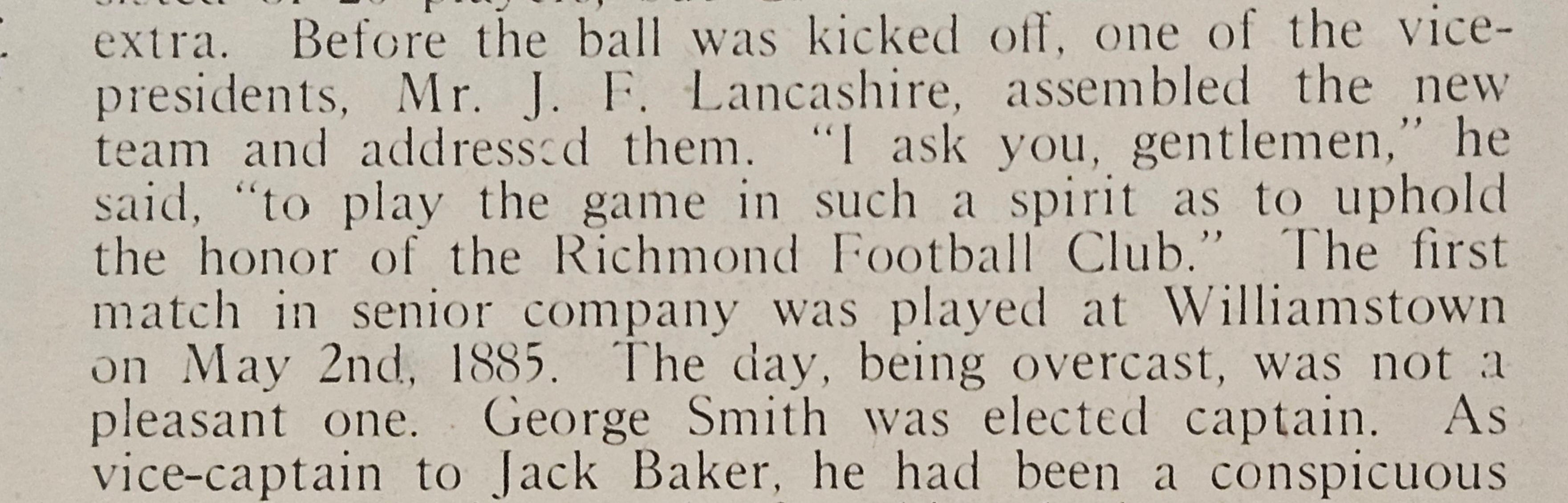
“I ask you gentlemen to play the game in such a spirit as to uphold the honor of the Richmond Football Club.”
When it came time to report on the same event in the 1951 history book, it was more truthful to the original, with no quotation.
But come the release of Tigerland in 1989, well the quotations are back, along with the incorrect description that Lancashire was the coach!
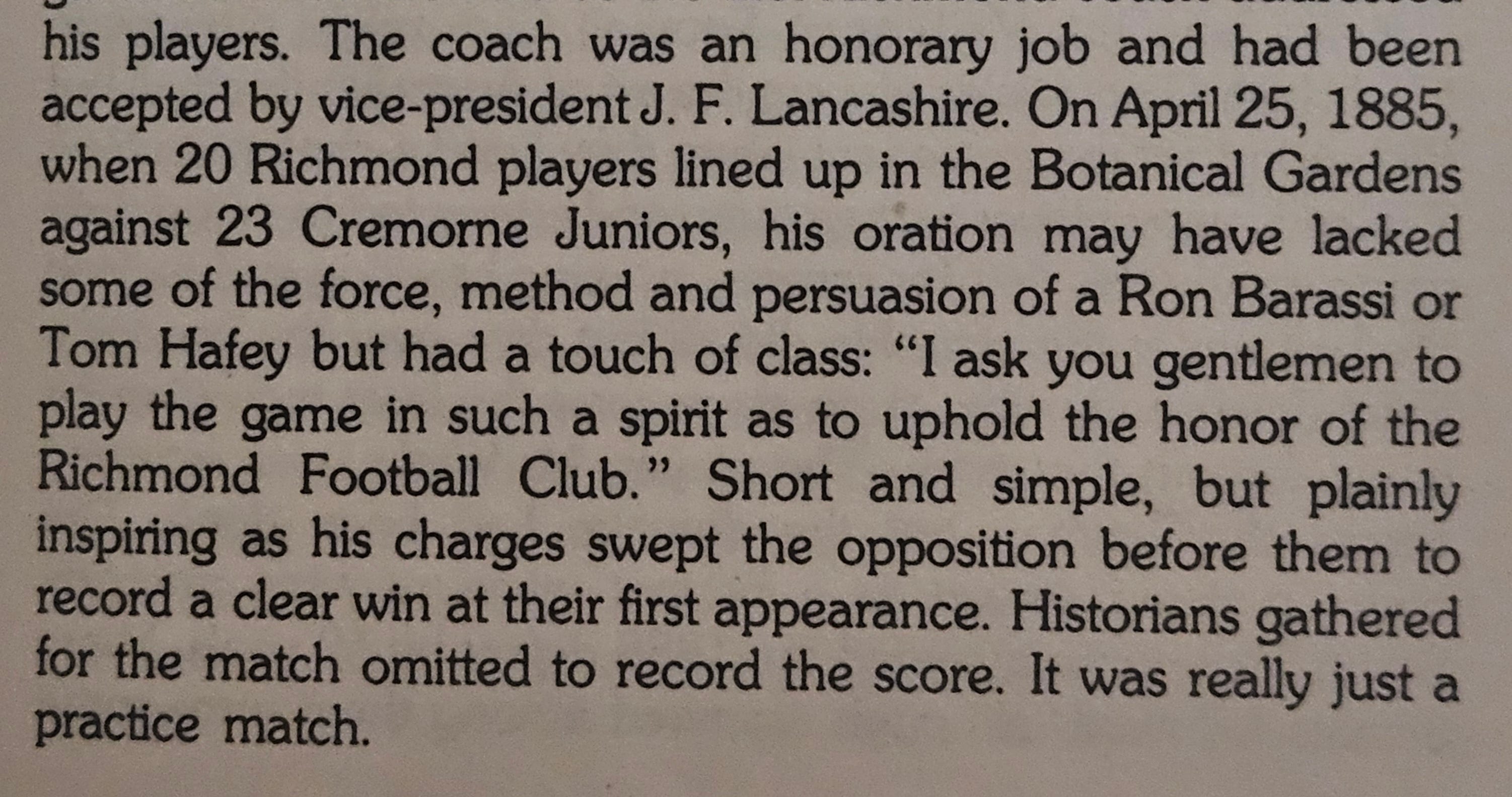
Also all 3 history books said this Cremorne match occurred at the Botanical Reserve, when infact it was on the Richmond Cricket Ground. Tigerland also said no one recorded the score; which is wrong.
THE FIRST GOAL
We know that Syle and Mullally kicked Richmond’s two goals, but who exactly did kick Richmond’s first ever goal in a non-premiership match.
Compare the pair below.
Firstly, the Richmond Guardian
“The leather was kicked in the direction of the Cremorne’s behind posts, where Syle came into possession and by a good screw kick landed first goal for Richmond amidst applause”.
And the Richmond Australian.
“The ball was then driven up and down the ground until Layton, of the Richmond, cleverly caught it, and sent it on to Mullaly, who put it through the posts, thus scoring first goal for Richmond”
So, was it Syle with a screw kick or Mullally?
And when it comes to the second goal, confusion again.
“…the oval was again sent forward and Watkins marking, in turn sent the ball on to Mullally, and that player, with a neat kick, placed goal No. 2 to the credit of the side”.
- Richmond Guardian
versus,
“The play after this continued very good, both clubs showed capital form, when Styles (sic), also of the Richmond, sent the ball through the posts, thus scoring another goal for his team.”
- Richmond Australian
On this day, when Richmond play their first ever non-premiership match, Vin Hannaford - who plays in Richmond’s second ever League match in 1908 - is born